

When the surface belongs in the story
Projection mapping aligns projected imagery with a physical surface. An arch, window bay or model edge can become the reference for a transition or visual cue. The service starts with the audience's task and the intended surface, then checks the fitted image at the venue.
Research on projected imagery describes registration to physical objects and coverage using multiple projectors. Equipment selection still requires assessment of the intended venue. Shader Lamps
Compare mapping with other display methods
Commission 3D projection mapping services when the relationship between the image and the surface helps communicate the message. A portable video, a readable information display and an illuminated façade have different requirements. Compare them under the same viewing conditions before choosing the format.
| Buyer task | Option to assess | Decision to test |
|---|---|---|
| Tell a story through a façade or model | Surface-mapped projection | Alignment and message clarity from audience positions |
| Show a video within a fixed frame | Projector and screen | Reading distance, light and portability |
| Provide readable content with limited light control | A suitable self-emissive display | Brightness, size and installation in the proposed setting |
| Emphasise architectural features with light | Architectural lighting | Intended visual treatment and venue restrictions |
For a wall that responds to visitors, consider the interactive wall service. Where foot movement drives the experience, the interactive floor service addresses a different input and testing task. A timed mapping sequence can be commissioned without visitor interaction.
Façades, stages and physical models
A landmark story
Assign an approved part of a local story to a recognisable façade feature. The first deliverable can be a transition between two chapters, tested from central and side viewing areas. Agree how someone arriving halfway through a loop identifies the chapter they are watching.
A product model at a booth
Use the model's edges to reveal a feature or explain how parts relate. The product owner clears the model and its representation. Test one reveal at the intended viewing distance before commissioning the complete sequence.
A gallery interpretation
A curator can select a cleared replica or approved surface to explain a carved detail. Keep essential interpretation available through readable text or another suitable route when motion or narration carries the explanation. Confirm what the projected treatment adds to the existing label.
A stage reveal
Tie a brief visual to a specific line or launch cue. The producer approves the audience positions and timing. Rehearse the cue with the actual lighting and sound, including how the presenter continues if the visual is unavailable.
Survey the venue and audience positions
Projection mapping implementation requirements begin with surface dimensions, photographs with a scale reference, finish, colour, protrusions and openings. Mark authorised projection zones and areas to exclude, such as a working door or an information sign. Record access, mounting candidates, power and public paths with the venue lead.
Choose a main viewing position and a side position. A black-box stage may allow controlled light and a seated audience; an exhibition aisle has passing visitors and competing displays. A public frontage needs a plan for where people gather and what can obstruct the view. The organiser supplies the show window and the venue confirms which conditions can be maintained.
Check light, surface and equipment together
Surface colour, reflection and ambient light affect the visible image. Assess them alongside geometry, coverage and available projection positions. Modern Approaches to Augmented Reality explains these relationships and calibration principles; brightness specifications require a site assessment. Technical reference
Test a representative patch of the actual surface. Where several projectors overlap, review visible joins and colour differences. If the required text is washed out, consider controlling light, moving the show window or changing the display method before full production. The selected lenses, playback equipment and operating conditions belong in the technical proposal.
Design content around the surface reference
Use a marked photograph, measured drawing or suitable model to place each visual. For example, motion can follow two arches while an Arabic title occupies an uninterrupted wall panel and a doorway remains excluded. Give the title, motion and transition a clear role in the story.
Approve Arabic and English wording, line breaks and display order in the storyboard. Test both versions from the intended audience positions. If spoken narration or animation carries essential information, provide an accessible text or static information route appropriate to the setting. A repeated loop also needs a readable entry point for people who arrive late.
Clear footage, music, artwork and other assets before the final export. Agree edit rounds and reuse rights, including any editable originals. For historical interpretation, the curator identifies which features are documented and which are reconstructed, and how the audience will understand that distinction.
Define production, hire and operating responsibilities
Video mapping services may involve content for client-supplied AV, an equipment package, a managed show or a repeat installation. Ask the provider to confirm which model it can deliver and who owns each task. A projection mapping rental price may omit content, calibration or an operator.
| Quote component | What to confirm |
|---|---|
| Survey and concept | Reference surface, message, viewing points and outputs |
| Content production | Scenes, languages, assets, revisions and licensed uses |
| Equipment and venue work | Projectors, lenses, playback, mounting, power and responsible parties |
| Test and rehearsal | Access window, lighting, test version and sign-off owners |
| Show run | Crew, cues, operating dates and recovery responsibilities |
| Breakdown and handover | Removal, permitted files, settings, training and licence terms |
When comparing a projection mapping company or studio, ask who designs the visuals, who validates the geometry and who runs the show. Projection mapping artists and the AV team need the same surface reference and accepted version of the sequence.
Test one scene before committing to the whole show
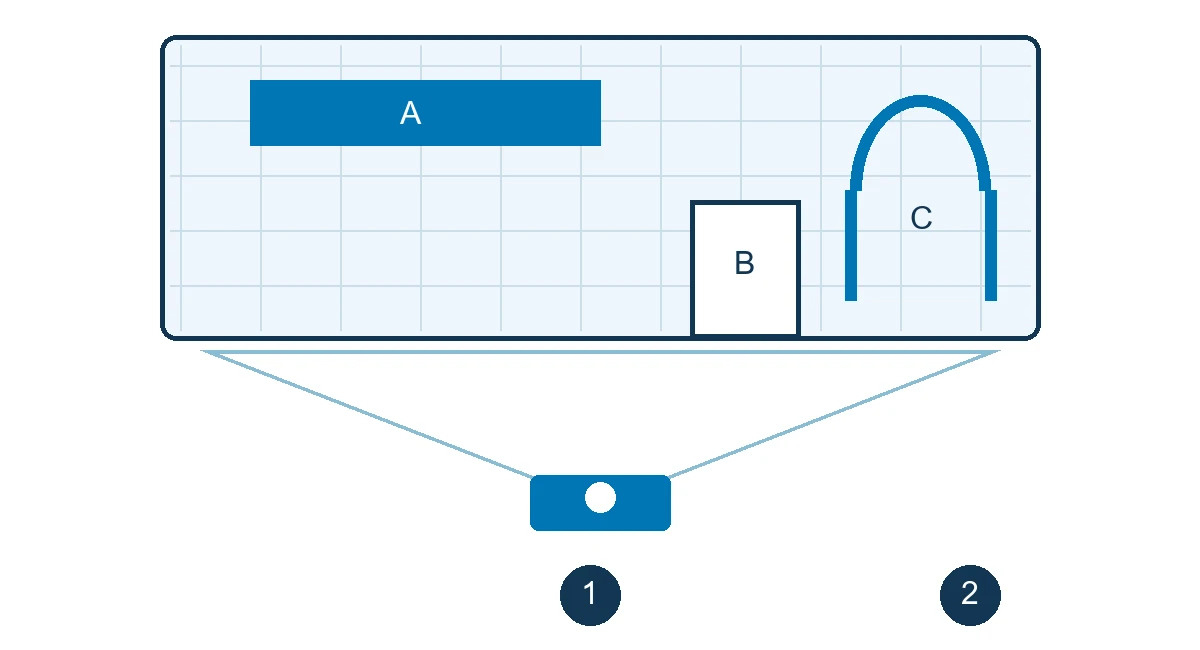
Choose a short scene that exposes the difficult decisions: text, motion near an edge and an excluded area. Project a reference grid and then the scene under representative light. Review it from both viewing positions and test its ending, transition or loop reset.
In the façade trial diagram, A is the title area, B is an excluded opening and C is a landmark for the motion. Viewing points 1 and 2 represent the centre and side. Record the rehearsal light on the test sheet. The diagram defines the review task without prescribing dimensions or equipment.
If the scene fails, record the cause and the next decision. You might move text to a flatter area, revise the viewing geometry, change the show window or use another display method. Discuss your projection mapping project with one scene, its message and someone authorised to approve site access and the trial.
From the venue brief to the rehearsal
Start with the message, surface and access schedule. Use the survey to prepare the surface reference and storyboard, then obtain content and rights approval. Surface complexity determines whether measured photographs are enough or whether a more detailed model or survey is needed.
Resolve the trial findings before producing the remaining scenes. At installation, check alignment, excluded zones and any overlaps, followed by a rehearsal with sound and lighting where included. Treat changes to the surface, mounting, light or assets as changes to the tested assumptions, with an agreed effect on work and dates.
Agree on visual and operational acceptance
Set acceptance criteria and retest responsibility before the rehearsal. Record the content version, surface reference, equipment settings, viewing points and light conditions. Technical sign-off and audience understanding answer different questions and should have separate records.
| Check | What to observe | Evidence to retain |
|---|---|---|
| Motion at landmark C | Registration to the chosen physical edge | Viewing points, version and findings |
| Excluded opening B | Image stays outside the agreed zone | Mask boundary and visible spill |
| Title area A | Legibility from the centre and side | Language, distance and display duration |
| Overlapping images, where used | Visible seam or colour difference | Configuration and representative test scene |
| Sound or stage cue | Agreed start and transition timing | Cue, operator and rehearsal result |
| Recovery from a representative stop | Fallback or restart at the agreed point | Steps, responsible person and retest result |
For comprehension, select a question about the chapter or detail the show should communicate. Record responses with viewing conditions and sample limits. Attendance and video views alone do not establish understanding or a financial return.
Venue permissions and content rights
The organiser identifies who checks activity approvals, while the venue authorises the surface, equipment locations and access. Review public routes, power, sound and heritage restrictions with the relevant site specialists. Content approval does not by itself authorise a mounting position or every type of event.
Confirm the framework applicable to the activity and project date with the competent authorities. The entertainment legislation published in Umm Al-Qura in 2026 has a deferred commencement provision; the organiser should verify the rules applicable to the proposed date rather than assume a universal mapping permit. Official text
Record rights to display, adapt and record the supplied assets, including music and footage. For a sensitive heritage feature, begin with curator and property approval. A cleared replica or an approved adjacent surface may be an option to assess.
Projection mapping cost and scheduling
The cost of projection mapping depends on the surface, viewing and light conditions, access, content, licensing, equipment and show operation. Separate survey and prototype costs from full production, delivery, setup, calibration, rehearsal, run days and breakdown. An existing loop on an indoor prop and a custom outdoor launch across several surfaces require different quotes.
For a seasonal venue show, compare an appropriately licensed adapted loop with a custom narrative on the same approved surface and operating schedule. Residential projection kits are a separate purchase decision. Ask each provider for the same scope and exclusions when comparing a projection mapping price.
For a project in Riyadh or elsewhere in Saudi Arabia, provide the venue address, dates and access window so the team can confirm coverage, travel and staffing. Work backwards through permissions, asset approval, revisions and rehearsal. A dated delivery plan follows that review; no standard number of weeks applies to every show.
Operation, support and reuse
Name the show caller, playback operator, fallback decision maker and person responsible for keeping audience paths clear. Rehearse a representative interruption and restart, retaining the accepted asset version and settings. For an outdoor venue, agree operating conditions and who can stop or postpone the show.
Confirm support hours and the permitted scope of live changes. Handover can include the cleared playback master, calibration references, cue sheet, operating notes and training as agreed. List editable files and licence permissions separately.
Before moving the show to another venue, review the new surface geometry, equipment positions, audience areas and rights. Establish which assets can be reused and which masks, alignments and tests must be repeated. Include the new installation in the acceptance test.
Two documented examples and Saudi applications
From the Sails: Light Years, Sydney Opera House
In October 2022, the Opera House projected a film about its building and people onto the sails nightly, with a synchronised soundtrack. The institution documents the implementation, without supplying an impact measure that can be promised for another project. Opera House account
At an approved Saudi cultural venue, assign two chapters of a local story to distinct frontage features. Check whether the transition reads from central and side audience areas and whether any sound cue lands at the intended point. Clear the story and surface with the venue before the trial.
Color the Temple, The Metropolitan Museum of Art
The museum's 2015 account describes a projected colour interpretation of one carved scene at the Temple of Dendur. The team selected a wall away from direct sunlight and described the reconstruction as hypothetical because conclusive colour evidence was unavailable. Project team account
For a Saudi gallery, ask a curator to select a cleared replica of a detail and distinguish documented features from interpretation in its caption. Test alignment to the relief, then ask visitors to explain that distinction. These are external examples, not Marafei project references.
Brief Marafei for a scoped proposal
Marafei's projection mapping service designs and delivers a visual experience around an approved surface, content and scenario. Bring one message, a venue and a show window. Identify who can approve the creative work, the surface and the test result so the proposal has clear deliverables and responsibilities.
Share authorised photographs, approximate dimensions, audience positions, light conditions, languages, rehearsal access and the status of permissions. State which inputs still need a survey. Discuss your projection mapping project to define the trial, production and operating scope.