Skip to content

Mini Golf Game

Mini Golf Game is a physical putting course where groups move between holes and aim to finish in the fewest strokes. It suits event, resort and leisure-venue projects, with hole count, dimensions, obstacles and equipment selected for the audience, site and rental or permanent scope.

Pricing depends on configuration and project scope

Request a quote
Hole and course count
Based on area and flow
Lane dimensions
Designed for the site
Materials
Selected for the environment
View all specifications

Product details

Specifications

Details determined by the venue

Play uses physical lanes. Count, dimensions and materials are choices; access, lighting and operating footprint require venue approval.

Specifications
SpecificationHow it’s determinedConfirmation
Hole and course countBased on area and flowApprove for configuration and site
Lane dimensionsDesigned for the siteApprove for configuration and site
MaterialsSelected for the environmentApprove for configuration and site
AccessReviewed in planningApprove for configuration and site
LightingBased on operating hoursApprove for configuration and site
Specification approval boundaries

Values come from model documentation or approved drawing and sample. The start-rate example is hypothetical, not verified capacity.

  • Hole and course count — Separate playable holes from complete courses; link layout to observed group starts and completions.
  • Lane dimensions — Document unit and obstacle dimensions, stance and transition space, and packed delivery dimensions.
  • Materials — Approve surface, edge and obstacle samples, fixing, care, exposure and drainage documentation where needed.
  • Access — Review entry, exit, queue, edges, approach to play and ball, and service access.
  • Lighting — Check ball, cup, obstacles, numbering, glare and shadows during actual operating hours.

Description

What is the Mini Golf Game?

Mini Golf Game is a physical putting course where players use a putter and ball to reach each hole in as few strokes as possible. It suits event producers, resorts and leisure venues planning a round in which groups move between stations. Hole count, dimensions, obstacles and equipment depend on the venue, audience and proposal.

A hole is one playing station; a complete course contains a set of holes. Keep these counts separate in the enquiry and review the five specifications and quote inputs. Request an inventory of putters, balls, obstacles and signs, with setup, lighting and operation itemised.

How a round works

The operator issues equipment and explains start markers, putting and station order. Agree scoring, turn limits and the procedure for a ball leaving the lane before opening. A group waits until the next hole is clear, then follows the numbering. Equipment is returned and checked before reissue.

Assign group release, retrieval of stuck balls and temporary hole closures. Where a marshal is required, state coverage hours and duties in the proposal. Hole count alone does not determine round duration; briefing, walking, waiting and ball retrieval also take time.

Choose the use and course format

For an indoor exhibition, review group changeover, loading access and floor protection. At a resort, plan repeat use, care and storage. For a seasonal event, relate operating hours to weather, lighting and supervision. Trial equipment and challenge with the intended users; putters and obstacles do not suit every age automatically.

Compare setup formats
FormatBuyer decisionConfirm in the proposal
Portable courseTemporary round across stationsModule size, assembly, removal and storage
Permanent installationRepeat use, ownership and careBase, fixing, drainage and maintenance
Single putting stationShort challenge without a multi-hole roundSize, turn-taking and format availability

An inflatable format is a separate request requiring equipment and operating specifications and confirmed availability. A Golf Simulator uses shot tracking and virtual play. Compare a single-zone group activity such as Giant Chess, or a digital movement activity such as an Interactive Floor, where relevant.

Five specifications and acceptance evidence

Play is physical; count, dimensions and materials are configuration choices, while access and lighting require venue review. Obtain module measurements and operating limits from exact-model documentation or an approved drawing and sample.

Specifications and evidence
FieldAcceptance evidenceOwner
Hole and course countSeparate counts, layout and observed flowOperations and technical team
Lane dimensionsUnit size, stance and transition space, packed dimensionsTechnical team and venue
MaterialsSurface, edge and obstacle sample, fixing and careSupplier and venue
AccessEntry, exit, queue and approach to playVenue and intended users
LightingBall, cup, numbering and shadows during operating hoursLighting and operations teams

Playing footprint and circulation

Draw each unit to its dimensions, then add stance, putting and transition space. Mark equipment issue, queues, spectators, exits and equipment return on the same plan. Include turns, obstructions, pedestrian routes and exits in the footprint.

Check the loading route against the largest packed part, doors, lifts and crew access windows. Rehearse two groups moving and a ball-retrieval task before approving the layout. HSE crowd guidance informs audience, route and site review; the actual venue approves its requirements.
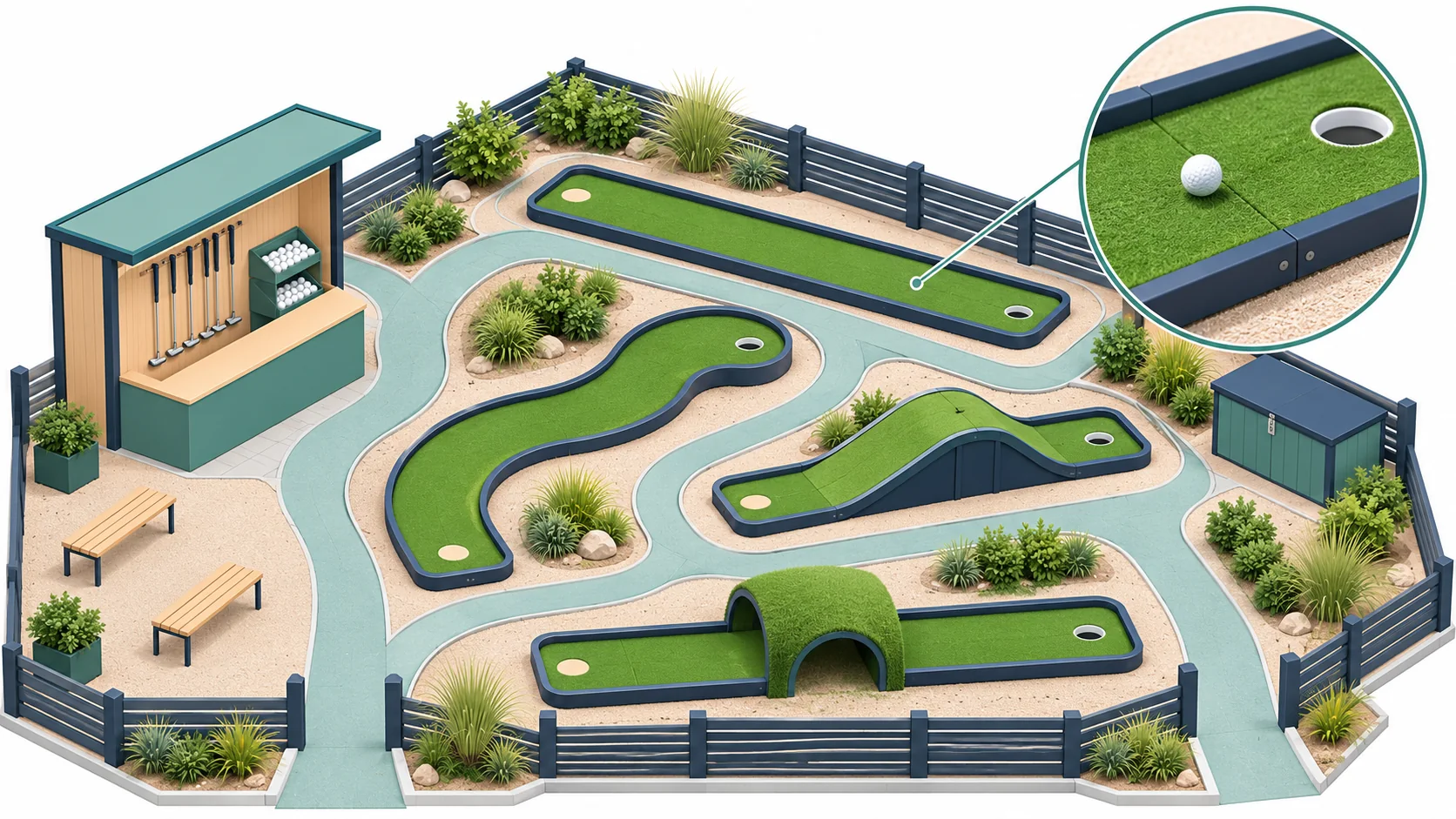
Concept of mini golf lanes with varied obstacles, a separate circulation path, equipment point, waiting and a cup-and-join detail
Unscaled layout concept; count, space and access require an approved venue plan.

Hole count and group start rate

Planning example only: assume six sequential holes, one group per station slot, and a slowest station that clears after six minutes. If other stations, transitions and resets add no further bottleneck, the theoretical interval is six minutes: 60 ÷ 6 = 10 group starts per steady-state hour. At four players per group, that equals 10 × 4 = 40 player starts.

These are assumptions, not product capacity or completed rounds. Record starts and completions separately. Measure briefing, walking, ball recovery, stoppages and reset in a representative trial, then agree the operating interval and queue. Adding a hole does not raise the start rate if the same bottleneck remains.

Obstacles and ball movement

Begin with a readily understood station, then select a bend, ramp or tunnel for the group’s level. Test ball movement from different starting positions, across joins and near obstacles. Observe unintended stopping or deflection, entry into the cup and ease of retrieval.

Agree putter sizes, ball type, quantities and spares for the selected course. When requesting individual modules or equipment, check surface height, joins, cup and equipment compatibility; parts from different systems need not connect directly.

Surfaces, materials and outdoor use

Review the base, unit stability, edges, playing-surface documentation and cleaning. Outside, assess heat, sun, wind, wet conditions, drainage and storage. Request evidence for claimed weather or slip performance of the configuration, and assign who closes a hole and checks it before reopening.

HSE slip-and-trip guidance addresses surfaces, obstructions and cleaning; it does not rate the product material. Permanent installation requires base, drainage and maintenance decisions. Temporary setup needs floor protection, removal and reinstatement arrangements.

Access and lighting

Review connections from entrance to starting areas, holes and exit, including edges, turns and ball access. The U.S. Access Board miniature-golf guide addresses connected routes and start areas. It is a US design reference, not evidence of Saudi compliance. Agree applicable requirements with the responsible venue team and trial the layout with intended users.

Test lighting during actual operating hours: ball, cup, obstacles, numbering and transitions, plus glare and shadows from the player’s position. Separate existing venue lighting from project-supplied lighting and review power and cabling where requested.

Branding and instructions

Approve a sample showing colours, obstacle, numbering, branding and round instructions. Test ball, cup and edge contrast and keep sponsor assets clear of ball paths and circulation. Agree languages, artwork rights, finish and replaceable parts before production.

Customisation affects transport, cleaning and reset time, so include samples and testing in the schedule. A themed obstacle does not establish that electronic scoring or digital effects are included; specify those additions and functions separately if requested.

Acceptance, operation and upkeep

Match modules and equipment to the inventory and drawing, then inspect stability, edges and joins. Test a putt and retrieval near an obstacle, followed by equipment issue, two-group circulation and lighting. Record defects, the correction owner and retesting before admitting visitors.

Assign opening checks, cleaning, inventory, closing and storage. Follow material and equipment instructions and agree how unstable parts or changed surfaces are handled and reopened. Specify training, support, replacement and warranty in writing rather than assuming a standard term or coverage.

Rental, permanent installation and cost factors

Compare mini golf game prices for the same hole count, dimensions, obstacle complexity, materials, equipment and duration. Separate site preparation, branding, transport, setup, staffing and removal from ongoing care, storage and replacement. A visitor ticket or home set price does not establish event installation cost.

Rental and permanent scope
ItemTemporary hirePermanent installation
Modules and equipmentCount, size, inventory and hire periodOwnership, count, sample and components
VenueLoading, assembly, checks, removal and reinstatementBase, fixing, lighting and drainage as required
OperationStaff hours, equipment issue and changeoverChecks, care, storage and agreed training
ReplacementDamage or equipment-loss procedure during hireMatching parts, support and warranty terms

Timing follows design, sample, artwork, crew-access and availability confirmation. Send the address and date to verify transport, coverage and services, and request exclusions. For later expansion, review connections, circulation, lighting and drainage, then measure flow again.

Documented examples for venue planning

The 2026 Tredyffrin libraries programme describes play inside two libraries and sponsor-designed holes. It is a published programme, not a capacity test or commercial result. For a proposed Saudi event in an existing hall, preserve circulation and test equipment issue as two groups arrive, with sponsor artwork rights reviewed.

The Saudi Press Agency report on Golfi at SEVEN Abha describes a 12-hole attraction. That count belongs to that destination, not a Marafei package. For a proposed resort, plan varied challenge and a clear first station, then measure the slowest station and test transition instructions. Neither example is a Marafei project or a promise to supply the same installation.

Information for a quote

Send city, address, dates, duration and operating hours, plus a plan, photos and surface and entrance dimensions. Identify users, group size, expected arrivals, requested holes, branding and lighting, with responsibility for staffing, care and storage. Add loading and removal windows and door or lift constraints.

Request a proposal separating hole count from complete-course count and listing unit dimensions, equipment, materials, site services and acceptance criteria. Request a mini golf quote.

Installation & operation

Course, equipment and operating setup

Materials and details follow the environment and use case.

Playing lanes

Modules or layouts designed around the dimensions and visitor route.

Obstacles

Ramps, curves, tunnels, and challenge elements suited to the audience.

Clubs and balls

Playing equipment selected for the target age groups.

Edges and surfaces

Finishes that guide the ball and suit the installation environment.

Identity and signage

Colors, graphics, instructions, and hole numbering within scope.

A clear round from start to finish

Actual operation depends on course count and visitor volume.

Collect equipment

Players receive clubs, balls, and round instructions.

Start the course

The group begins at an assigned station and records strokes if required.

Move through obstacles

Players progress in order while keeping the next lane clear.

Complete the round

Scores are collected, equipment is returned, and the course is prepared for the next group.

Surface, circulation and services

The environment is reviewed before design approval.

Floor and levels

Check that the surface can receive the proposed configuration.

Circulation

Define entry, exit, and waiting without groups crossing each other.

Weather and drainage

Outdoor sites require review of sun, rain, wind, and water drainage.

Storage and maintenance

Provide space for equipment, cleaning supplies, and replacements.

Supervision

Assign responsibility for starting rounds, inspections, and visitor volume.

From a permanent course to a seasonal experience

Scope follows site and operating review.

Permanent implementation

Specify ownership, base, materials, lighting, fixing, care, warranty and replacements in the proposal.

Temporary setup

Confirm count, equipment, dates, availability, transport, setup, staffing, removal and reinstatement separately.

Phased development

Review added modules, join compatibility, circulation, lighting and drainage, then retest flow after expansion.

From round planning to course opening

The proposal confirms the actual schedule.

Understand the audience

Define age groups, expected round duration, and operating model.

Design the course

Lay out stations, obstacles, identity, and visitor flow.

Implement and test

Install the configuration and test ball movement, circulation, and lighting.

Train and hand over

Agree staff guidance, training where needed, inventory, care, storage and hole-closure procedures; document handover.

Checks and round management

Rules follow the selected materials, site, and audience.

Course checks

Review edges, surfaces, and obstacles before opening.

  • Review edges, surfaces, and obstacles before opening.
Group spacing

Prevent a group entering a lane still in use.

  • Prevent a group entering a lane still in use.
Suitable equipment

Select clubs and balls for the target groups and venue rules.

  • Select clubs and balls for the target groups and venue rules.
Clear access

Plan paths and instructions that are easy to read and understand.

  • Plan paths and instructions that are easy to read and understand.
Supervision and maintenance

Assign a person to manage flow, cleaning, and temporary closure for repairs.

  • Assign a person to manage flow, cleaning, and temporary closure for repairs.

Frequently asked questions

Details are confirmed after site review.

What should a mini golf game rental quote include?

Ask the provider to list hole count, layout, playing equipment, delivery, installation, staffing and removal. Clarify hours, branding and any venue preparation or exclusions.

Can I buy a mini golf game for a venue?

Use an enquiry for permanent or repeat use. Ask whether supply is offered, who designs and installs the layout, what must be prepared and who handles inspection, upkeep and replacements.

How is a mini golf game price calculated?

A project quote reflects the number and complexity of holes, materials, branding, logistics and operating scope. It differs from a visitor ticket or a packaged home set.

What should I budget for after a mini golf game is installed?

Ask which surfaces and parts need inspection or replacement, who provides storage and cleaning, what crew is required, and whether support is included. Record ongoing costs separately from supply and installation.

When is a portable putting green enough?

Choose one putting station for a short challenge with limited space. A sequential mini golf course offers several starts, obstacles and transitions; ask the supplier which format is available.

Can a venue source individual mini golf holes?

Request confirmation of individual modules and check how they connect to the existing layout, surface heights, cup positions and reset routine. Do not assume parts from different systems fit.

How do I compare an indoor mini golf rental with an outdoor setup?

For indoor use, check floor protection, doors, route and storage. Outside, check surface stability, grip, water runoff and weather exposure. Confirm materials and installation conditions before choosing.

How many mini golf holes are suitable?

Start with the usable area and group release pattern. Test a small layout with the expected audience before adding holes or quoting throughput. Ask whether the supplier's count refers to holes or whole courses.

Is mini golf suitable for children and adults?

Match putter size, ball handling, challenge and rules to the groups expected. Confirm supervision, venue access and any age-specific limits with the operator.

Can mini golf be installed outdoors?

Outdoor use depends on the site and proposed materials, base, drainage, fixing and weather plan. Agree the pause and restart criteria with the venue before opening.

Can the mini golf course be branded?

Request a mock-up for colours, sponsor panels, scorecards and signs. Approve the finish and its care documentation and check that branding leaves play and circulation clear.

What details are needed for a mini golf quote?

Provide city, dates, operating hours, a plan and photos, audience and forecast arrivals. Specify desired holes, loading access, surface, branding and staffing requirements.

How do I check portable mini golf course rental near my venue?

Give the city and site address first. Ask whether the supplier covers the date, how much access time it needs and whether delivery, setup and collection are included.

Does mini golf rental include all playing equipment?

Confirm the number and sizes of putters, balls and spares, scoring materials and any signs, storage or reset kit. Ask who issues and counts equipment at opening and close.

How much space does mini golf need beyond the lanes?

Allow space for the approach and exit at each hole, queues, group turns, equipment return and other venue traffic. Have the operator and venue review a marked plan and walk the proposed route.

How do I estimate mini golf group starts per hour?

Time the slowest station and include reset and transitions. If one group can start every six minutes, that is up to ten starts in a steady-state hour. Validate it in a trial and track completions separately.

What should a mini golf operator check before opening?

Walk the route, check stability and joins, roll a ball across transitions, confirm lighting and mark queues and exits. Record who can close a hole or pause the course.

How can we plan mini golf access for different players?

Review the route from entrance to start, selected holes and exit. Check turns, approaches and instructions against actual user needs and applicable local requirements before approving the configuration.

What should the venue provide for mini golf delivery and collection?

Confirm door and lift clearance, load-in location, the largest packed module, permitted hours, protection of finishes and the crew responsible for returning the space.

Who looks after mini golf during an event?

Name the people responsible for group release, putter and ball counts, queue checks, cleaning and stop-play decisions. Clarify whether supplier staff are part of the proposal.

How does mini golf differ from a golf simulator?

Mini golf uses physical putting lanes and obstacles and players move through the course. A golf simulator serves buyers who want tracked shots and virtual play. Choose based on visitor activity and available space.

How early should I book mini golf?

Provide the event date and the first and last permitted access times. Request a confirmed schedule covering design, branding, installation and collection for the selected configuration.

What warranty applies to a mini golf installation?

Request warranty duration, coverage, exclusions and claims procedure for the specified setup. Do not assume one warranty covers lanes, equipment and site work.

Is inflatable mini golf the same setup?

It is a different configuration request needing equipment, operating and fixing specifications for the venue. Confirm availability, components and services before approval.

Does mini golf hole count mean complete-course count?

A hole is one playing station; a course contains a set of holes. Request both counts with the plan and dimensions to compare the same scope.

Is a mini golf project price an admission ticket price?

An installation proposal covers modules, materials, equipment, services and duration. A destination ticket covers a visit and does not establish rental or installation pricing.

Sources and references

  1. Miniature Golf Facilities

    U.S. Access Board

    Accessed:

    Design or documented-example reference; not evidence of supplied specifications or Marafei service inclusions.

  2. 2026 Charity Miniature Golf Classic programme

    Tredyffrin Township

    Accessed:

    Design or documented-example reference; not evidence of supplied specifications or Marafei service inclusions.

  3. Golfi at SEVEN Abha, 12-hole attraction

    Saudi Press Agency

    Accessed:

    Design or documented-example reference; not evidence of supplied specifications or Marafei service inclusions.

  4. Assess crowd safety risks

    HSE

    Accessed:

    Design or documented-example reference; not evidence of supplied specifications or Marafei service inclusions.

  5. Slips and trips: prevention

    HSE

    Accessed:

    Design or documented-example reference; not evidence of supplied specifications or Marafei service inclusions.

Publisher

Marafei

Publisher: Marafei

This product content was prepared, written and reviewed by Marafei’s team of specialists, consultants and technical engineers.

Marafei team

Don’t hesitate to
contact us.

You can book a demo with us by filling out this information, and we will get in touch with you as soon as possible

Business Hours

Sunday–Thursday
8:00 AM–6:00 PM