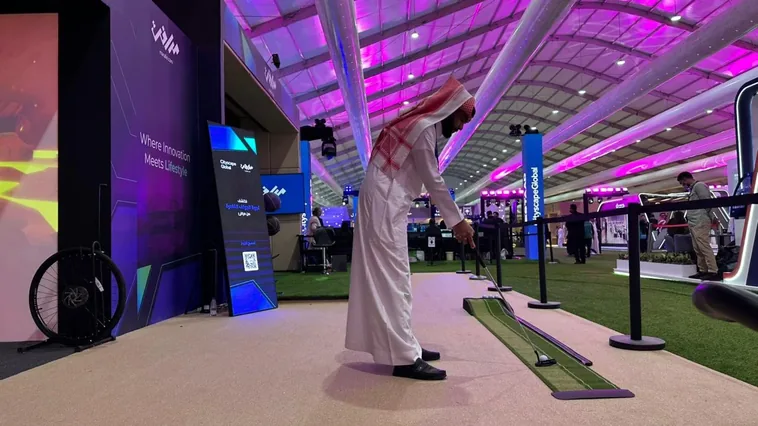
How a shot becomes a game or practice session
The player or operator selects an available mode, then the player hits from a mat towards a purpose-made impact screen. The launch monitor records the ball or club data supported by the configuration; the software uses those readings to display the simulated shot. Check the required metrics and modes against the proposed model and software edition. Manufacturer reference
Define the session before choosing equipment. A corporate event needs a short challenge, clear instructions and an orderly change of player. An academy needs the measurements a coach actually uses. A hotel or home installation also needs repeatable starts, a suitable viewing area and an operating routine.
What to compare in a complete golf simulator system
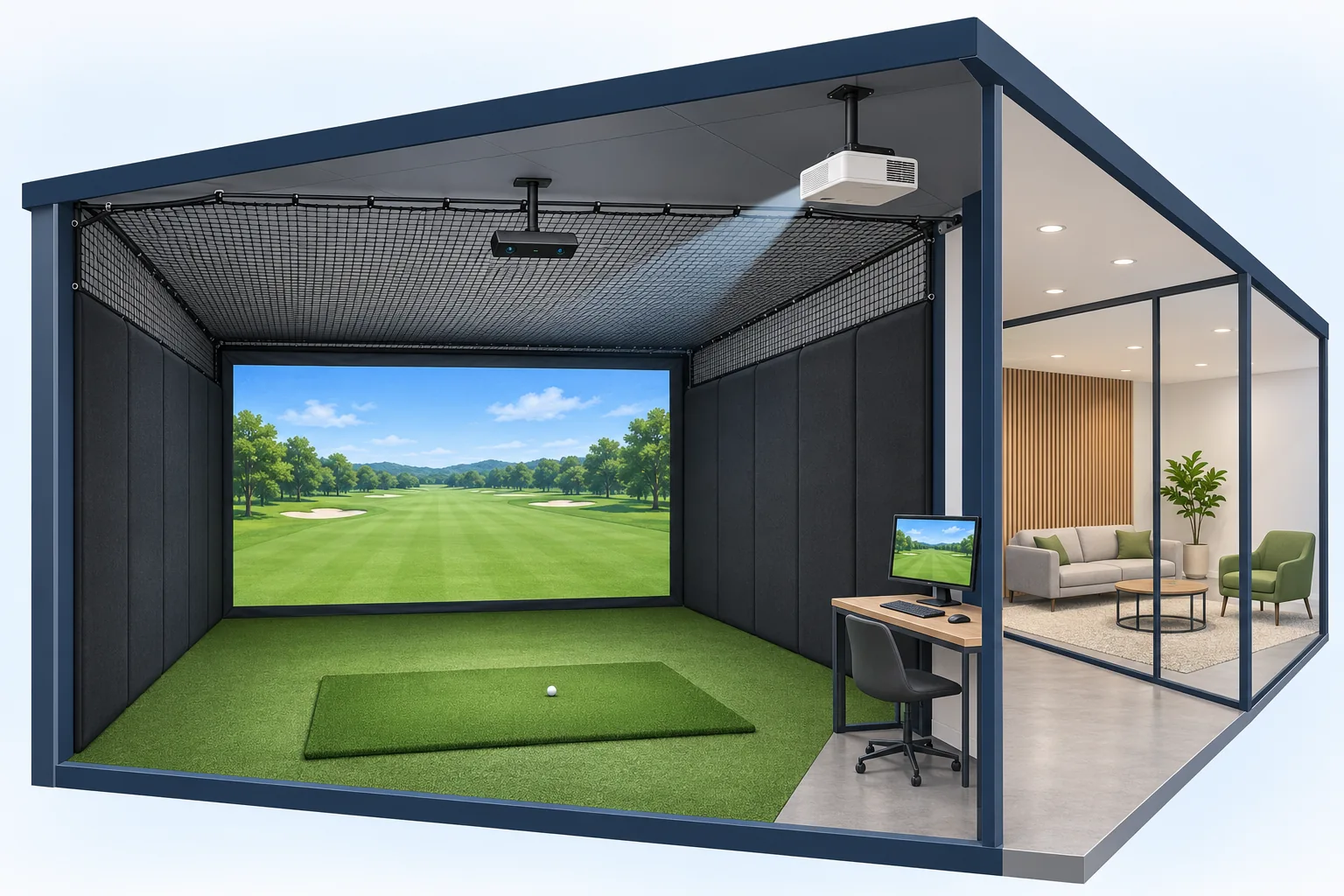
Request a bill of equipment that identifies each component, its function and who supplies and installs it. A launch-monitor-only listing has a different scope from a commissioned playing bay. Compare the complete scope before comparing totals.
| Component | Function | What the proposal should identify |
|---|---|---|
| Hitting area and protection | Hitting mat, impact screen and surrounding protection. | Materials, dimensions, screen fixing and player and spectator boundaries. |
| Launch monitor | Records the shot data supported by its model. | Exact model, mounting position, required metrics and calibration procedure. |
| Computer and software | Run the simulation and licensed modes. | Compatibility, software edition, license term, renewals and account ownership. |
| Projection and controls | Display the course and results and manage a session. | Resolution, throw and lighting; any touchscreen or audio included in scope. |
Audio, flooring, room finish and branded graphics should be itemized where required. An illustration does not establish package inclusions. Trackman’s specification page requires a current software license for Virtual Golf; the proposal must state what the license and renewal cover. Manufacturer reference
Room requirements depend on the model and layout
Measure finished width, depth and clear height. Mark beams, lights, doors and other obstacles. Locate the impact screen, ball and tracker on a plan, including space behind the screen, swing clearance and waiting areas. Review intended handedness and the longest club in scope during the site assessment.
| Model | Guide recommendation | Measurement boundary |
|---|---|---|
| Ceiling-mounted Trackman iO | Screen to ball: 3.0 m or more; width: 4.6 m or more; height: 3.0 m or more. | Allow swing space behind the ball. Screen-to-ball distance is not total room depth. |
| Trackman 4 behind the ball | Screen to unit: 5.5 m or more; width: 4.6 m or more; height: 3.0 m or more. | The unit needs space behind the ball. This endpoint differs from the iO example. |
These are model-specific planning recommendations, not Marafei package dimensions or approval of a particular room. The general specification page lists a recommended height of 3.1 m or more, while the planning guide gives 3.0 m. Do not automatically select the smaller figure: confirm the installation guidance for the chosen configuration against the measured room and swing clearance. Manufacturer reference; Manufacturer reference
Trackman 4 support guidance separately identifies minimum and optimal ball-to-screen and ball-to-unit distances, and clearance behind the screen. Floor area alone cannot establish fit. Have the installer reconcile measurement endpoints and protection in one site drawing. Manufacturer reference
Choose the setup around the venue and users
For an exhibition, specify the challenge, turn length, access window, removal time and queue location. Trial the changeover between players before estimating participation capacity. In a hotel, have staff demonstrate session start and stop, and check whether guests can read results from the viewing area. For coaching, make the requested shot data part of acceptance.
A home golf simulator needs the same assessment of obstacles, noise and swing clearance. An empty room or high ceiling alone does not establish suitability. An outdoor or partly open event setting needs its own assessment of conditions and equipment suitability; indoor requirements cannot simply be transferred to it.
Event rental or permanent installation?
Base the decision on frequency of use, project duration and operating responsibility. A training configuration describes an application and can be permanently installed. Agree the scope of each item in the proposal.
| Item | Temporary event rental | Permanent installation |
|---|---|---|
| Site preparation | Unit footprint, access, fixing, protection and setup window. | Room layout, finishes, utilities and maintenance access. |
| Transport, installation and removal | Delivery trips, handling, calibration, teardown and venue reinstatement. | Supply, installation, commissioning and responsibilities of other trades. |
| Staffing and training | Whether an operator is included, working hours, turn management and breaks. | Staff training and documented start, inspection and shutdown procedures. |
| Software and licensing | Required modes and license coverage for the agreed event period. | Edition, account ownership, term and any renewal fees. |
| Support and protection | Responsibility for faults, damage, delays and replacement during the event. | Maintenance, consumables, replacement, warranty and support terms. |
For golf simulator rental, send the venue, dates and operating duration so configuration and availability can be checked. If you plan to buy an indoor golf simulator, ask for equipment supply and room installation as separate lines. The project proposal establishes the contractual inclusions.
Golf simulator prices and ongoing costs
Start with the equipment scope: tracking, screen, protection, mat, computer, projection and software. Add the site work required for mounting, cabling, lighting control and finishes. A change in screen size or projector position can alter the installation, so include dimensions with the price request.
For event hire, request separate treatment of use duration, operator hours, transport, access and teardown windows, and branding. Identify whether the system moves between locations and who handles storage or security between operating periods. These are scope questions, not automatic inclusions.
For a permanent venue, distinguish initial supply and installation from any recurring software or support charges, agreed maintenance and replacement consumables. Compare proposals over the same period, with the same functions and acceptance tests. Ask the quotation to identify taxes and separately priced work. An hourly playing rate or an overseas equipment-only price cannot establish the cost of a system at your venue.
Verify tracking, software and projection together
Name the ball and club metrics users need, then check support in the model and software edition. Test how measurements are displayed and modes selected. Agree the purpose and permissions for player accounts, names or score displays before enabling data capture.
Check course detail and readable numbers under normal operating light, from both playing and viewing positions. The installer should reconcile screen size, throw, projector placement, shadows and computer performance at the proposed resolution. Do not assume 4K is included or universally necessary. Ask which functions require a network connection and how staff recover a session after an interruption.
A documented projection example in Riyadh
BenQ’s July 2026 Marafei Resort case identifies the LK936ST for primary projection and LU935 for secondary uses, with Trackman iO in the project context. These are supplier-published facts about that installation, not standard equipment for every proposed setup. Manufacturer reference
For a hospitality room with more than one use, identify the screen and mode required for golf and what the other use needs. Test switching and image visibility with the operating team. The case’s reported results do not establish a performance promise for a different venue.
Installation, operation and acceptance
Agree the site drawing, component list and responsibility for power, network and lighting before installation. After mounting and calibration, witness representative shots, agreed modes and data, picture checks, player changeover, and stop and recovery procedures. Test both handedness configurations when they are in scope.
Record the expected and observed result, venue conditions, issue owner and retest for each check. Request operating and daily inspection instructions, equipment and license details, and the limits of maintenance, warranty and support. Specify who rechecks alignment after moving equipment or changing the screen or tracker position.
Before admitting participants, the operator should check the screen, protection and hitting area and prevent circulation through the swing zone during play. Review participation, viewing routes and access needs with the venue. The installation and operation tab provides the practical checks.
Information for an installation or rental quote
For a golf simulator in Saudi Arabia, provide the city, venue and target date, followed by finished width, depth, clear height and obstacles. Add site photographs where useful. State whether the request is a temporary event or repeated use, with duration, daily hours, expected participants and the proposed turn arrangement.
Include coaching metrics or game modes, right- and left-handed use, existing equipment, branding and staffing requirements. These inputs support a discussion of configuration, responsibilities, price and availability for your location and dates. If you want a playing session at an existing venue, identify that request separately from supplying a system.