

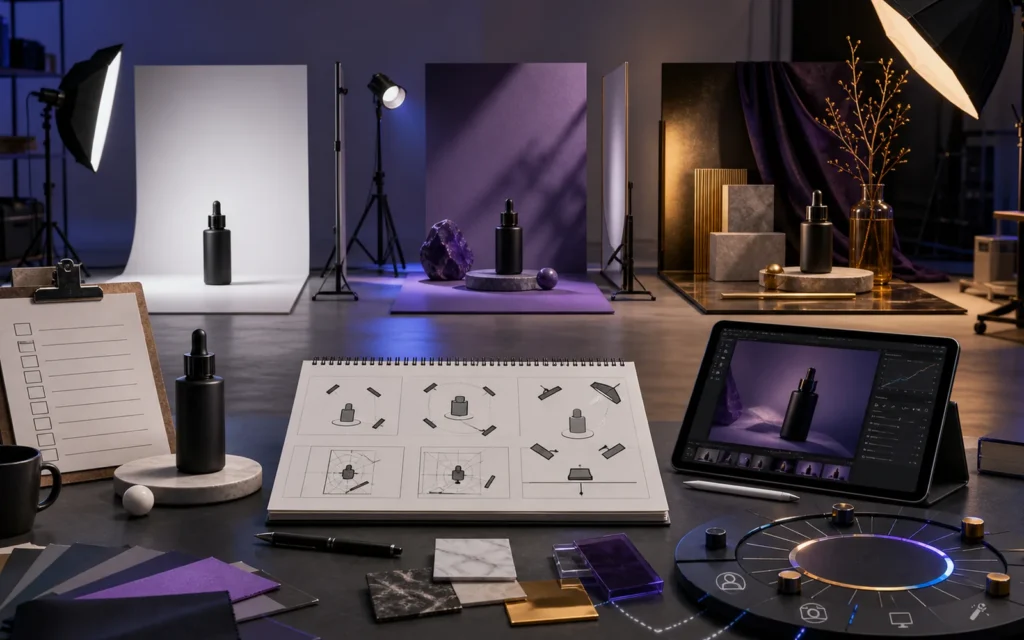
“How much is one product photo?” cannot be answered responsibly with one number. A simple white-background image differs from a styled campaign scene with set design and talent; ten similar products differ from a mixed catalogue of reflective, fragile and oversized items.
Break the proposal into pre-production, capture, post-production, delivery and rights. You can then compare like with like and see whether a price difference represents quality, scope or an unspoken risk.
Why a fixed public price list can mislead
A per-image price may hide sample handling, studio, equipment, crew, retouching and logistics. The lowest headline can become expensive when rush clipping, props or reshoots are added.
Rates change with time, city, availability and complexity. A useful number must include date, currency, tax basis, scope and an exact deliverable. This article provides a quotation model, not a binding tariff or an invented Saudi market average.
- Quantity is not enough; product similarity changes setup time.
- Final images are not the same as captures reviewed and rejected.
- Channels, territories and duration may change required rights.
- Rush timing, remote locations and sensitive products add resources and risk.
The components of a transparent quotation
Every proposal should identify inclusions, exclusions and assumptions. Use this map in the request and require suppliers to answer in writing.
| Component | Scoping questions | Risk if omitted |
|---|---|---|
| Pre-production | How many products, what reference, who approves? | Rebuilt sets and mismatched expectations |
| Studio and crew | Where, which equipment and specialists? | Overtime or missing equipment |
| Styling and props | Assembly, styling or purchased materials? | Unplanned purchases and delay |
| Post-production | Clipping, cleanup, colour and revisions? | Long reviews and inconsistent outputs |
| Delivery and rights | Formats, channels, duration and ownership? | Unusable files or rights gaps |
Three scope levels—not one package for everyone
A basic catalogue scope prioritises repeatable light and background. Editorial scope adds styling and context. Campaign scope may include a concept, set, talent, locations and wider rights. One catalogue can combine levels according to product priority.
Ask how the supplier charges: session, day, product, approved image or delivery bundle. No unit is always best. It must match the way change is priced and avoid double charging.
- Basic: repeatable lighting, background and clipping.
- Editorial: a styled use context.
- Campaign: concept, production and broader rights.
- Hybrid: catalogue coverage plus hero images for selected products.
Write a request that answers the expensive questions
Attach a product schedule with SKU, dimensions, material and condition, plus visual references explaining what is and is not desired. Define views per product, use, output size and format, target date and approval owner.
Name expected services: collection, assembly, cleaning, styling, props, talent, clipping, label cleanup and CMS upload. Silence does not mean inclusion.
Usage rights, ownership and delivery
The agreement should state ownership of final assets, whether raw files are included, permitted channels and duration, and any talent, location or licensed-element restrictions. Paying production cost does not automatically transfer every unlisted right.
Define naming, folders, colour references, formats, backup responsibility and retention. These details prevent avoidable reprocessing when the store or agency changes.
Compare proposals fairly
Build a matrix for scope, quality, process, rights and risk—not total alone. Request a representative complete sample, ask who performs the work, how many review rounds are included and what counts as a paid change.
Normalise working hours, waiting, cancellation, transport, tax and payment terms. If a large gap remains, request a written explanation rather than assuming expensive means better or cheap means efficient.
| Area | Look for | Warning sign |
|---|---|---|
| Scope | Deliverables and exclusions | General wording without limits |
| Quality | Relevant sample and acceptance test | Beautiful work unrelated to your material |
| Process | Owners and review milestones | Verbal approval only |
| Rights | Defined channels, duration and ownership | “All rights” without definition |
| Risk | Change and reshoot terms | Low price based on hidden assumptions |
Reduce cost without reducing quality
Supply clean, labelled samples, batch similar products, approve one representative image and avoid unused output sizes. Separate necessary correction from cosmetic enhancement and appoint one approval owner.
Saving does not mean compressing an impossible day. Reduce unnecessary variety, pilot the workflow or prioritise products instead of removing quality time from every asset.