

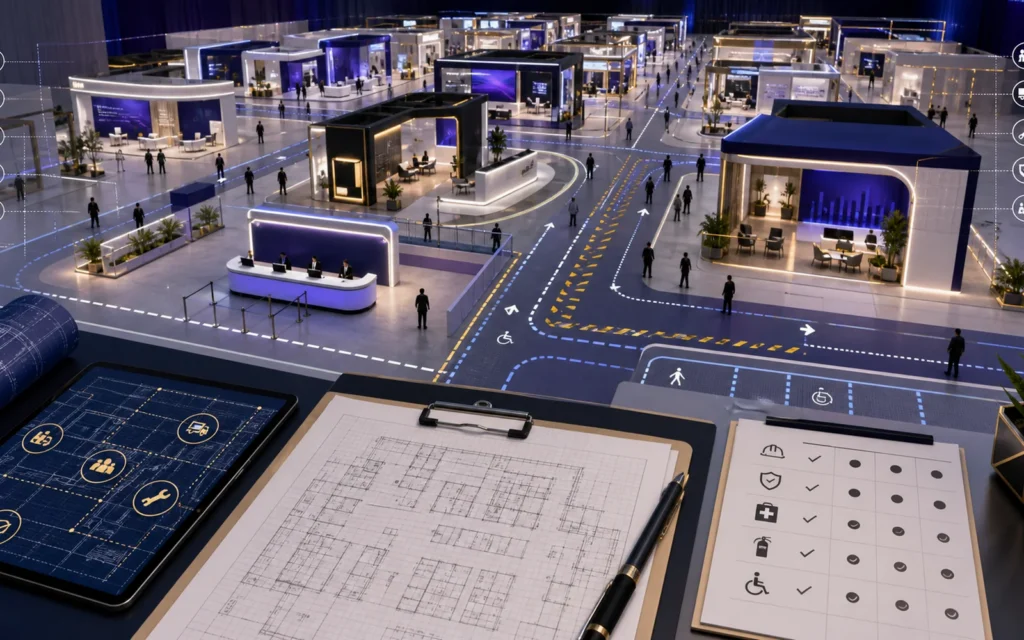
Exhibition success is not synonymous with visitor volume or a beautiful stand. The primary objective may be qualified meetings, a product launch, learning, market-making for exhibitors or service to a professional community. Each objective needs different space, content, operation and measurement.
The Saudi Conventions and Exhibitions General Authority provides an electronic licensing portal, and its FAQ notes that accompanying activities are licensed by their competent authorities. Always check the live service for the actual project rather than relying on a universal deadline or document list.
Define success before selecting the venue
Write one primary objective and two supporting objectives, then name the evidence, data source and decision owner. “Awareness” alone is vague; identify the audience and the behaviour that represents progress, such as a qualified meeting, a request or completion of a learning session.
Map owner, organiser, exhibitors, sponsors, visitors, speakers, venue and suppliers. Exhibitor success may differ from visitor success, so define value for each party and avoid promises without a mechanism or measurement plan.
- One primary objective directing space, programme and marketing.
- Audience segments defined by need, not only age.
- A clear value proposition for exhibitor, visitor and sponsor.
- Collectable indicators with an owner and later decision.
Licensing and regulatory dependencies in Saudi Arabia
Define exhibition type, organiser, venue, date, programme and accompanying activities, then use the official SCEGA e-portal to select the current service. Requirements vary and approval can depend on complete information or other permissions.
Entertainment, food, retail, recording or specialist installations may introduce additional competent authorities. Keep an approvals register and never assume the exhibition licence covers every activity. Seek official guidance or qualified advice when uncertain.
| Element | Question | Evidence |
|---|---|---|
| Classification | What is the format, scope and audience? | Matching official service and approved description |
| Venue | Are use, capacity and installations permitted? | Contract, plan and venue approvals |
| Accompanying programme | Does another authority have a remit? | Activity, owner and approval list |
| Content and rights | Who owns images, shows and music? | Documented licences and uses |
Select a venue for operations—not photographs
Compare usable capacity, loading, ceiling, power, connectivity, exits, parking, transport, accessibility, storage and hospitality. Gross area is not the same as sellable stand area.
Complete a technical visit with an early plan. Test registration, security, queues, service routes and venue restrictions on sound, rigging and construction. An undocumented restriction becomes an expensive change.
Design a legible floorplan and journey
Map registration, welcome, exploration, sessions, meetings, rest, support and exit. Distribute anchors so one stand does not drain every route, and avoid dead aisles and congestion at the entrance or stage.
Review public, exhibitor, service, emergency and technology layers with venue and operations. Seating, water, quiet space and charging are part of the experience, not wasted area.
- An entrance that explains destination and next action.
- Wayfinding legible at real viewing distance.
- Meeting areas that control noise and protect conversation.
- Service and waste routes separated from visitors where possible.
- Accessible alternatives that do not require repeated special requests.
Manage exhibitors and sponsors through information
Create an exhibitor manual for dimensions, loads, permitted materials, deadlines, power, connectivity, freight, insurance, safety, rights and signage. Collect data once and maintain a status board for missing information and approvals.
Sponsor packages must represent real, deliverable and measurable assets. Define placement, scale, duration, content deadlines and approval, and do not sell one exclusive asset twice.
Programme, content and session experience
Tie every session to an audience and learning or decision outcome. Collect biographies, decks, recording rights, language and technical needs early. Include checks, transition and questions, with a fallback for cancellation or presentation failure.
Do not make the stage compete continuously with stands. Use programmed quiet periods or tracks. Provide captions or interpretation where needed and test sound and sightlines from real seats.
Technology and data: use the minimum that serves the purpose
Define the job of registration, access, meeting booking, apps, screens and lead capture. Test devices, accounts and permissions, and maintain an offline or degraded mode for connectivity failure.
If visitor data is shared with an exhibitor, explain who receives it and why. Minimise fields and retention, and separate operational data from marketing where possible.
Operations, budget and risk
Build a work-breakdown budget for venue, design and build, technology, content, operation, safety, exhibitors, marketing, hospitality, logistics and insurance. Give contingency a rationale and owner. Cutting one line without understanding dependencies can move cost elsewhere.
Turn each risk into an owner, early signal and response: late freight, speaker absence, registration congestion, network loss, injury, weather or non-compliant material. Conduct readiness walks, team briefings and a soft opening test.
| Gate | Evidence required | Decision |
|---|---|---|
| Concept | Objective, audience, model and success criteria | Proceed to design and scope |
| Technical design | Plan, safety, power, network and access | Start fabrication and final booking |
| Content readiness | Files, rights, speakers and signage | Print, production and load-in |
| Operational readiness | People, communications, emergency and test | Open or resolve the gap |
Measurement and responsible close-out
Define actual attendance, meetings, session completion, space use and exhibitor feedback before the event. Registration is not attendance, and a scanned badge is not automatically a qualified lead.
Plan safe breakdown, material return, supplier settlement, data handover and a near-term review. Document evidence-backed changes, close system access and delete data whose purpose has ended.
Official sources and update checks
Requirements and programmes change. Check these official sources before making a decision or submitting an application: