

Define the result your event needs
Set a result you can review, such as meetings between exhibitors and buyers or sessions that produce committee-approved recommendations. Identify the audience groups and what each needs to do. Agree how the event owner will assess the result before choosing the programme and venue.
For a conference with an exhibition, check whether opening the floor coincides with arrivals for the first session. Shared registration and entrances need a coordinated timetable, while exhibitor and programme decisions retain distinct owners.
Exhibition, conference or a combined brief?
| Format | Main workstream | Evidence to review before opening |
|---|---|---|
| Trade exhibition | Floor allocation, exhibitors, services and visitor flow | Approved plan, exhibitor manual and load-in handover |
| Conference or congress | Programme, speakers, sessions and committee decisions | Approved agenda, speaker files, cue sheet and rehearsal |
| Conference with exhibition | Shared registration and transitions between floor and rooms | Integrated timetable tested with overlapping arrivals |
A participant commissioning one stand should use the exhibition stand and booth design and build brief. Venue hire or AV installation alone also needs its own scope. Agree how the commissioned teams hand work over to one another.
Specify who performs, approves and pays
For each deliverable, name the execution owner and approval owner, the dependency, fee basis and latest decision date. Record evidence of completion and the fallback if the dependency is not ready. The client's authority over business goals and commercial commitments should remain explicit.
For room allocation, operations prepares the layout and the authorized client and venue representatives confirm it. For exhibitor approval, the floor team checks the request and routes technical exceptions to the venue. For registration, the registration lead prepares test records and the client confirms access categories. For an authority submission, name the eligible applicant and who supplies the supporting documents.
Separate selling exhibition space or sponsorship from delivering contracted benefits. Define who signs and collects payment, and who supplies exhibitor services and reports. If the client books the venue or AV directly, record access, technical interfaces and escalation between those suppliers and the organizer.
Connect delegate and exhibitor journeys
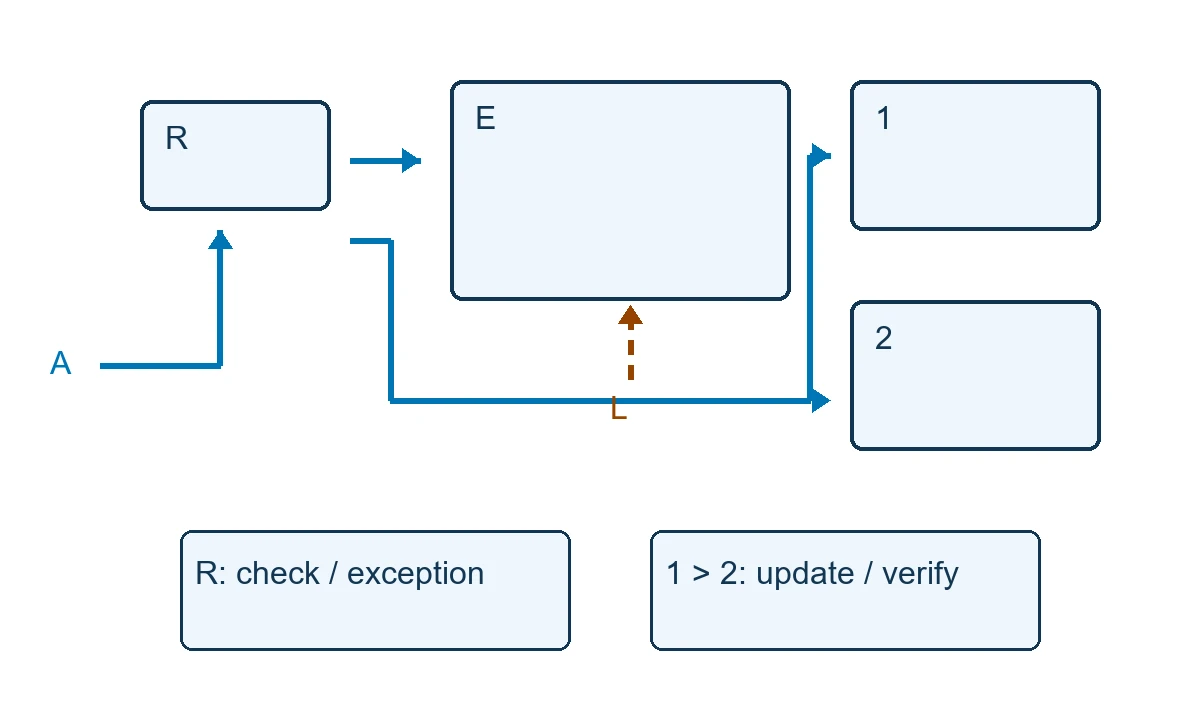
Map the delegate's invitation, registration, confirmation, arrival, help, session access and departure. Compare an invited delegate or scheduled buyer visit with an arrival requiring a registration exception. Assign queue supervision and a place for resolving exceptions without holding up routine checks.
Map the exhibitor's allocation, manual, service orders, freight booking, passes, load-in and handback. A late request for extra power needs a technical decision, price approval and delivery owner before anyone commits to it.
The conceptual diagram shows attendee entry A through registration R toward exhibition E or session rooms 1 and 2. The dashed route takes exhibitors from service access L to E. Transfer these routes to the actual layout and review accessible entrances and support points with the venue. This coordination sketch is separate from the approved evacuation plan.
Programme, speakers and language support
The programme committee approves topics, abstracts where relevant, speakers and outputs. The organizing team coordinates the schedule and logistics within its remit. Set deadlines for speaker files, reviews and translations, and prepare a moderator brief and a backup for missing slides or an unavailable presenter.
The public agenda gives session names, times and rooms. The internal run sheet also records speaker arrival, file handoff, stage cues, changeovers and decision owners. Give both a revision number and approval date, allowing time for walking between rooms and resetting equipment.
Scope Arabic and English by channel: registration, signs, stage materials and participant support. Interpretation, captions, streaming and recordings need explicit coverage, operators, connectivity and rights. Rehearse the agreed fallback and how the room programme continues if a remote channel stops.
Choose the venue and confirm approval dependencies
Compare capacity for the proposed layout, parallel rooms, loading hours, services, connectivity, accessible routes and booking terms. A second track adds staffing, materials and rehearsal dependencies alongside room hire. Have venue specialists confirm occupancy, exits and applicable fire protection requirements, using SBC 801 where applicable.
The responsible party should check the event category, eligible applicant and current route through SCEGA's services. Record required documents, owners and decision dates before public commitments. The project's category and venue determine its dependencies; a coordination contract does not guarantee a licence or establish a universal processing time.
Walk the route from arrival through registration to seating and facilities. Agree how guests request assistance and access essential information, and test the support included in the scope before advertising it.
Adapt the work to the sector and format
A trade fair needs exhibitor services and buyer routing. An association congress needs committee sign-off and track management. A technology event adds demonstration and network questions. For cultural or heritage exhibits, check material rights and the intended visitor route alongside the event classification.
For healthcare meetings, separate logistics from scientific review and any applicable accreditation or sponsorship decisions. Where professional development accreditation is required, the eligible provider checks SCFHS CPD activity accreditation. Do not announce credits based on an organizing proposal alone.
A professional conference organizer, often called a PCO, can coordinate agreed congress workstreams. IAPCO's service list is a scope reference, not evidence of Marafei membership or accreditation. Allocate travel, hospitality and destination logistics separately when required. Standard PCO services.
Decision points from brief to closeout
| Stage | Decision owners to identify | Evidence before proceeding |
|---|---|---|
| Objectives and contracting | Event owner and procurement | Deliverables, exclusions and budget assumptions |
| Venue and classification | Applicant and venue specialists | Approval route, layout, services and booking conditions |
| Programme and exhibition plan | Committee and floor lead | Agreed revisions and material deadlines |
| Suppliers and registration | Contract and registration owners | Quantities, permissions and test plan |
| Rehearsal and opening | Operations and acceptance owners | Results and closure of opening blockers |
| Removal and reporting | Client, suppliers and data owner | Venue handback, reconciled items and agreed report |
Assign the latest decision date and consequence of delay to each stage. If the programme changes late, recheck print, translation and technical commitments. Build the timeline backwards from opening and site access; ask for project-specific deadlines rather than a standard lead time.
Compare quotes using the same assumptions
Give providers the same duration, access windows, venue status, room count, delegate and exhibitor estimates, languages and reporting needs. Compare staffing by room, shift and peak period. Ask for the organizer's fee separately from venue and supplier charges, allowances, options and applicable taxes.
Identify fixed and quantity-dependent charges, direct client contracts and items awaiting a supplier price. Confirm overtime, change approval, cancellation exposure and quote validity. Set priorities for the venue, programme, registration, access and staff before adding streaming or further rooms.
Use documented relevant experience, sample deliverables and rehearsal criteria to compare organizing partners. Check who accepts the work in each proposal you compare. Prepare the details for a comparable quote.
Test registration and decide how data is used
Agree access categories and test advance registration, an onsite exception, duplicate scanning, badge replacement and loss of connectivity. Use synthetic records in rehearsal. Name the supervisor who approves an offline procedure and how check-ins will be reconciled when the system returns.
The data owner defines the purpose, necessary fields, authorized users, permitted sharing, retention and handover or deletion responsibilities. Keep check-in separate from optional sponsor lead capture and review photography and recording permissions. A sponsor agreement or badge scan alone does not settle access to an attendee list. Review the actual process against the PDPL Implementing Regulation.
Rehearse simultaneous handoffs before opening
Run a registered delegate's arrival while a late exhibitor requests access and a room manager reports a delayed speaker. Agree the project's acceptance thresholds and sign-off owners before the trial. Record the decision, time, recovery action, audience message and recheck result.
| Rehearsal case | Team action | Acceptance evidence to agree |
|---|---|---|
| Registration exception | Check a test badge and route an exception | Delegate reaches the correct destination without blocking routine checks |
| Late exhibitor request | Floor and venue leads review the service | Recorded decision, payer, delivery owner and deadline |
| Room swap | Update agenda, signs, reception and speaker brief | Matching session identity and destination across channels |
| Missing file or connection | Use the approved fallback | Permitted operation continues and reconciliation work is recorded |
Escalate safety findings to the venue specialists. The authorized owner decides opening readiness after blockers are resolved. During delivery, keep one escalation path between registration, stage, rooms and the exhibitor team, and confirm that each affected team receives a change.
Handover and event reporting
Agree removal, venue handback, final programme, operating issues, supplier reconciliation and authorized reporting. State the delivery date and report approver, plus ownership and access rights for any files or recordings included.
Separate accepted registrations, unique check-ins, repeat entries, session attendance and remote views. Record the data source, unit, denominator where relevant and limits of deduplication. Keep exhibitor counts, completed meetings and qualified enquiries distinct, with qualification defined before the show.
For a conference, compare delivered sessions and approved recommendations with the agreed outputs. Assign follow-up ownership if required. Attendance alone does not establish commercial return or professional impact.
Two external examples for a Saudi event brief
MWC25 Barcelona: preserve reporting categories
GSMA reported 109,000 attendees at MWC25 and more than 2,900 exhibitors, sponsors and partners as a combined category. Its release reports speakers and the Ministerial Programme separately. The combined figure is not a count of exhibitors alone. Organizer's release.
For a Saudi trade fair with sessions, have the reporting owner approve definitions of a unique attendee, repeat visit, session check-in and meeting before registration opens. Test a draft report with synthetic repeat entries and reconcile totals to their agreed sources. Keep co-located datasets separate; Barcelona's figures provide context, not a forecast for your event.
MONDIACULT 2025: connect the programme to an output
UNESCO published a provisional programme for MONDIACULT 2025 in Barcelona and a separate outcome document recording commitments by ministers and authorities responsible for culture. The programme sets out sessions; the outcome document records commitments. Provisional programme, outcome document.
For a Saudi association forum, give each track a rapporteur, summary template, deadline and committee approver. Move a workshop during rehearsal and check the agenda, room signs and speaker brief, while keeping its recommendation attached to the session ID. This is a proposed project test; the UNESCO documents do not establish attendance or other operating results.
Share your brief with Marafei
Provide the objective, format, city, dates or window, venue status and estimated delegates, exhibitors or speakers. Add rooms, programme stage, languages, budget and decision contacts. Mark uncertain quantities as estimates; no attendee list is needed for initial scoping.
Identify included workstreams and contracts your organization holds directly. Ask for a responsibility matrix with deliverables, execution and approval owners, dependencies, dates, evidence and fallback arrangements. Public institutions can specify a bilingual scope and formal approvals log, with procurement and protocol requirements confirmed by their own teams. Verify delivery coverage and logistics for the actual location, whether Riyadh or another city.