

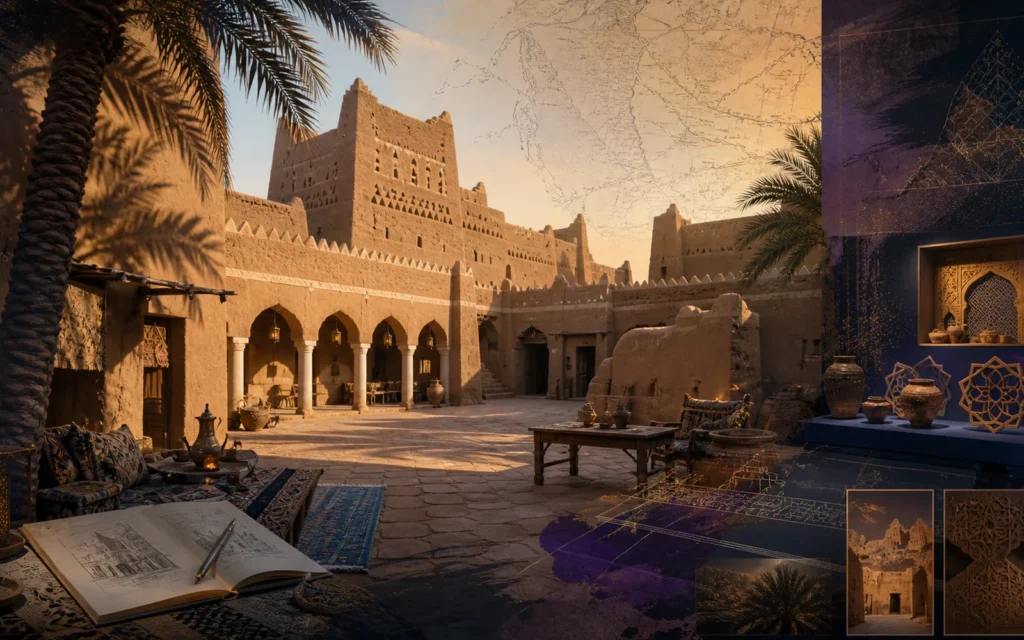
Saudi Founding Day falls on 22 February and, according to the official site, marks the foundation of the First Saudi State by Imam Muhammad bin Saud in 1727. It differs from National Day on 23 September, which commemorates the declaration of the unification of the Kingdom in 1932. Confusing the two weakens otherwise polished content.
A responsible event turns meaning into a journey suited to audience and place. It begins with sources and a clear message, then selects activities, visual language, technology and operations. Always verify the official identity and guidance current for the relevant year.
Founding Day and National Day are not interchangeable
Founding Day focuses on historical roots and the beginning of the First Saudi State in Diriyah in 1727. National Day relates to the unification and declaration of the modern Kingdom on 23 September 1932. Each has its own historical context and message.
Create an approved fact sheet before scripting. If the programme expands into people, clothing, architecture or dialects, involve a qualified reviewer. A dramatic story is not worth using when its source cannot be established.
| Occasion | Annual date | Historical focus |
|---|---|---|
| Founding Day | 22 February | Beginning of the First Saudi State in 1727 |
| National Day | 23 September | Declaration of the unified Kingdom in 1932 |
Choose one message and a real audience
The message might be understanding roots, connecting generations, exploring craft and material, or creating a platform for local practitioners. One message does not remove variety; it prevents a collection of unrelated activities.
Segment by age, language, mobility and prior knowledge, then define expected dwell time. An open family destination needs different wayfinding, rest and facilitation from a one-hour employee session or a supervised school programme.
- One cognitive or emotional goal.
- A primary audience—not only “everyone”.
- Expected visit duration and arrival pattern.
- Simple core copy with optional deeper layers.
Build ideas from meaning, not a template
Possible formats include an interactive timeline, place-based maps and stories, practitioner-led craft workshops, oral-history sessions, a documented material or clothing display, an audio journey, or a family question trail. Technology is useful only when it reveals a relationship that a static format cannot.
Credit practitioners, artists and sources, and agree recording and publication rights. Avoid presenting one region as the whole national story or using objects merely because they look “heritage”.
- A sourced timeline connecting events, place and people.
- A material station explaining object, use and maker.
- Short audio with transcript and translation where needed.
- A practitioner-led workshop with context.
- Question prompts that invite intergenerational conversation.
Narrative, visual identity and review
Maintain a content board linking each message to source, copy, image, usage right and reviewer. Apply the official identity guide current for the occasion when available; do not redraw a logo from an unknown file or reuse an obsolete pack.
Write in layers: clear heading, concise explanation, optional depth. Proof names and dates, then test legibility at the real distance and lighting.
Design the visitor journey and programme
Map invitation to exit: what should visitors know before arrival, where is the premise introduced, what requires booking, where do people wait, and how does the experience close? Balance noisy and quiet activity and offer choices rather than one long compulsory route.
For stage content, include transitions, technical checks and recovery time. State capacity, booking, language and sound level. A schedule without contingency turns one delay into a day-wide failure.
| Stage | Design question | Readiness evidence |
|---|---|---|
| Before visit | What does the visitor need to know? | Accurate invitation, place, time and access |
| Arrival | How is direction and premise understood? | Welcome and congestion-free route |
| Participation | What does the visitor do? | Clear activity, material, facilitator and capacity |
| Closing | What meaning travels home? | Summary, verified resource or responsible takeaway |
Access, safety and comfort
Provide essential information in legible text with good contrast and alternatives for audio or visual content. Review routes, seating, toilets and quiet areas. Do not make the only interaction dependent on standing or precise touch.
Assign crowd, emergency, first-aid, fire, lost-child and weather responsibilities with the venue and competent authorities. Decorations, cables and effects must not compromise fixing or escape routes.
Measure what the experience was meant to do
Use indicators tied to the goal: can visitors state one correct idea, complete the route, access the intended activities and use the support provided? Collect the minimum data, explain its purpose, and never assume permission to publish identifiable visitor or child imagery.
After the event, separate evidence from impressions. Review use by station, recurring questions, faults, congestion and facilitator notes, then turn them into decisions for the next edition.
Official sources and update checks
Requirements and programmes change. Check these official sources before making a decision or submitting an application: