

Give the stand a clear job
Choose what visitors should do: inspect a product, understand an initiative, try a demonstration or attend a meeting. Use that task to decide the aisle-facing message, the reception position and the space the exhibit needs.
A technology exhibitor might demonstrate one function before discussing its application. A public-sector team might introduce an initiative through a map and then explain a project. Agree the message and next step before approving the appearance, including what your team will count as an enquiry worth following up.
Walk two visitor routes before approving the layout
Trace both routes on the same scaled drawing. Rehearse them with team members, running the demonstration as a meeting guest arrives. Mark crossings that obstruct movement or hide the message.
A visitor approaching from the aisle
The visitor sees the message, reaches the host, watches a demonstration and leaves. Locate waiting space within the approved boundary and check whether the audience blocks the display for people approaching. Move the counter or shorten the demonstration if the route becomes congested.
A guest arriving for an appointment
The guest needs a visible meeting point and someone to direct them. Test access to the seat while a demonstration is underway, including the host's return to reception. Record layout changes before submitting the design for approval.
Match the exhibit and the open sides
A physical product needs dimensions, weights and handling arrangements reviewed by the relevant specialists. A software demonstration needs a viewing position and controls the host can operate. Meetings need an agreed number of seats and degree of privacy, with surrounding noise considered.
An inline booth generally presents one open face; a corner stand can face two aisles, subject to the booking. An island layout needs messages and hosting points suited to several approaches. Confirm the actual open sides and boundaries before placing any display or queue.
For a healthcare or pharmaceutical exhibitor, have the appropriate product team approve the demonstration and displayed claims. The Ministry of Health's record of CPHI Middle East 2024 provides a Saudi sector example, not approval for another exhibitor's materials. CPHI event record.
Shell scheme, space only and modular options
Read the booking contract and service schedule first. Shell scheme and space-only packages vary by event. The Gulf Print & Pack Saudi Arabia 2025 manual, for example, assigns provision within a space-only footprint to the exhibitor. Use your own show's current manual for decisions. Organiser's manual.
| Option | Check before design | Resolve in the quote |
|---|---|---|
| Upgrade an organiser's shell scheme | The walls, flooring, name panel and services actually included | Permitted alterations, graphics, furniture and additions |
| Commission a custom stand on booked space | Dimensions, open sides, service points and build rules | Drawings, approvals, fabrication and installation responsibilities |
| Use modular components | Fit on this footprint and the next intended layout | Ownership or hire, storage and reassembly |
Exhibition stand design addresses the exhibitor's space. If the commission also covers recruiting exhibitors, programming an event or operating the halls, define that wider work separately.
Plan for one show or repeat use
Compare a bespoke build, modular components and trade show booth rental against your intended event schedule. Ask which pieces you retain after breakdown, which return to the supplier and which can accept new graphics. A different footprint or number of open sides can change what fits.
For hire, confirm availability, dimensions, branding options, condition, damage terms and return arrangements. For owned components, include packing, freight, storage and inspection before reuse. Better Stands encourages component reuse; confirm whether your event uses the programme and which requirements apply. No particular rating or saving follows from choosing a modular design. Better Stands.
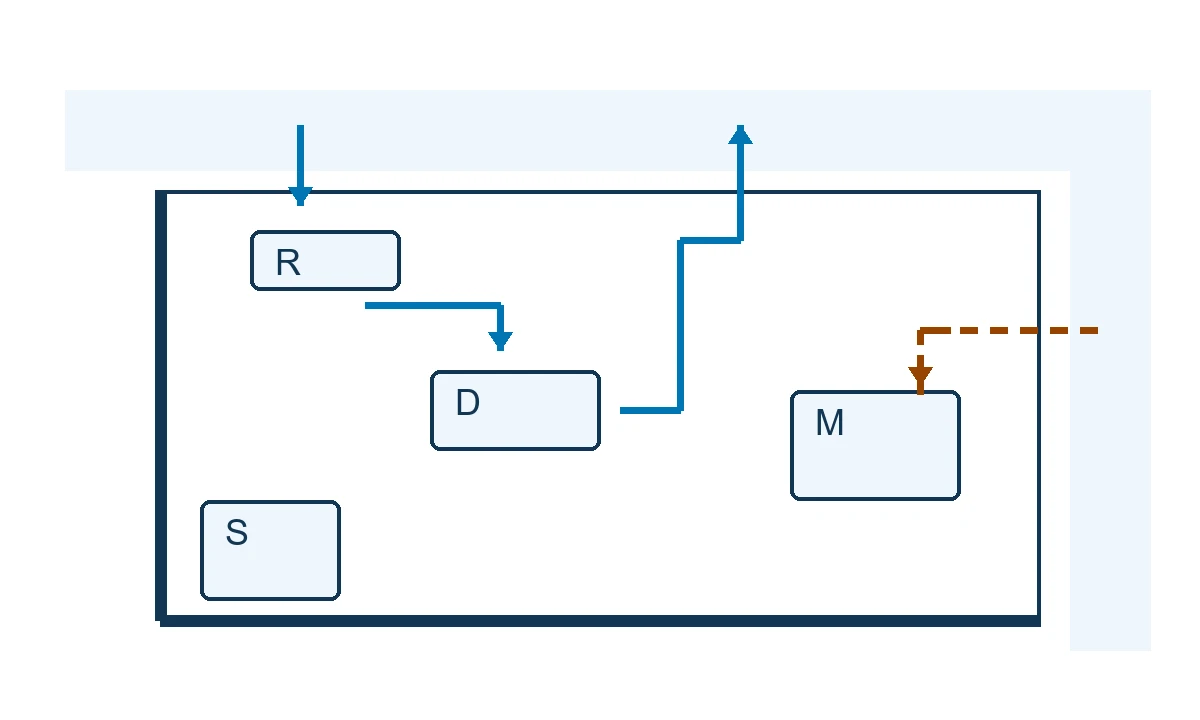
The illustrative corner-stand plan places reception R, demonstration D, meeting M and storage S within the booked boundary, beside two aisles. A solid line marks the walk-up route and a dashed line the appointment route. It is a movement concept, not a scaled construction drawing; transfer both routes to the actual dimensions before approving the layout.
Branding, displays and meeting space
Supply cleared logos, copy, translations and product files. Agree print dimensions, materials and proofs, and review how the exhibitor's name reads from the approaches. Place storage where staff can retrieve materials without blocking visitors.
For a screen or interactive wall, specify the visitor task, equipment position and operating requirements. Test the content under representative hall lighting and noise. If the stand includes a dedicated immersive area, scope the digital room with its entry, exit and staffing requirements.
Set the privacy needed for meetings, then review seat orientation, partitions and audibility. A display wall or banner is one line item within the stand design; it needs to work with reception, demonstrations and circulation.
Approve more than the rendering
The rendering shows the proposed appearance. Review it alongside the scaled plan, elevations, service positions and material schedule. Reconcile the stand number, dimensions and open sides with the booking, and ask for any missing elements to be drawn.
Approve a print proof or finish sample when it affects the decision. Identify the drawing revision covered by the price, consolidate comments and close them before releasing fabrication under the required approvals. A later change to graphics or dimensions needs a recorded cost, schedule and approval impact.
Two examples of spatial sequencing and reuse
Saudi Arabia's pavilion at Expo 2025 Osaka
The Saudi Press Agency describes a route from an outer courtyard to an inner courtyard in the pavilion designed by Foster + Partners. It also documents cultural studios for visual arts and music. Pavilion design, cultural studios.
For a smaller Saudi trade-show booth, a proposed adaptation is a recognisable welcome point followed by one demonstration zone, with a meeting route beside it. Test whether both visitor groups find their destinations during the demonstration. The different scale and programme require a new layout; this is a test for your brief, not a reported result from Osaka.
Ypsomed's modular exhibition stand
Ypsomed reports reusing most of its stand structure, including flooring, furniture and signage elements, across exhibitions. The exhibitor's account.
For two planned shows with different footprints, ask the designer to place the retained components on both drawings and identify replacement graphics. After breakdown, reconcile the parts inventory with condition and storage records. Assess readiness for the second show and calculate your actual costs; the case does not establish a saving for another stand.
What determines a stand design and build quote?
Cost depends on the footprint, design, materials, exhibit and services required. Give competing providers the same drawing and exhibitor manual revision. Request separate entries for:
- Design, revision rounds, drawings and the agreed approval work.
- Fabrication, finishes, graphics, flooring, furniture and included equipment.
- Packing, freight, site access, installation and pre-opening checks.
- Agreed operation or support, followed by dismantling, removal, storage or returns.
- Organiser and appointed-supplier charges, applicable taxes and who pays them.
If a quote offers a “complete package”, check its deliverables and exclusions, change rates, approval arrangements and validity. State the Saudi city and site-access dates as pricing inputs; proximity searches do not establish a contractor's availability or coverage for your show.
From drawing approval to move-out
Work backwards from opening through handover, rehearsal, installation, load-in, fabrication and drawing approval. For each stage, record the input the team needs and who can accept the completed work. Include the move-out window and removal responsibilities.
| Work or service | Name the responsible parties | Completion evidence |
|---|---|---|
| Drawings and approval | Preparer, reviewer and organiser submission owner | Revision number and authorised response |
| Power and connectivity | Ordering party, payer and inspecting specialist | Order confirmation and supplied-service check |
| Furniture and equipment | Supplier, payer and receiving person | Item list, condition and operating check |
| Installation and handover | Site lead and exhibitor representative | Acceptance record with assigned open items |
| Breakdown, storage and returns | Contractor, payer and custodian | Exit record, inventory and delivery receipt |
Name the responsible people in the table before sign-off. For an exhibitor based outside Saudi Arabia, identify who approves files remotely and who accepts the stand on site. Include cross-border freight and access credentials where they apply.
Accept the build, then assess the event
Compare the installed stand with the signed drawing. Rehearse the demonstration and meeting at the same time, recording each issue, owner, correction deadline and recheck.
| Check | Review on site | Record |
|---|---|---|
| Dimensions and finishes | Boundaries, elements and approved samples | Differences and agreed corrections |
| Message and movement | Reading from the aisle, entry, waiting and exit | Obstructions or conflicting routes |
| Equipment and operation | Content, controls, services and fallback | Trial result and operating owner |
| Meetings and storage | Access to seats and materials during a demo | Privacy and usability findings |
Count visits, completed demonstrations, meetings and qualified enquiries separately. Define a qualified enquiry before the show, such as a relevant requirement and an agreed next step. Technical acceptance alone does not establish commercial performance.
On-site operation and late requests
Name a shift lead, technical contact and change approver. Train the host to start and stop the demonstration and use an alternative explanation if equipment stops. Rehearse that switch before visitors arrive.
Changes to a logo, stand location or power point can affect approved work. Record the cost, timing and approval consequences before proceeding, including organiser review when required. Agree how staff will shorten demonstrations or manage waiting within the approved area when the stand becomes busy.
Event rules, safety and accessible movement
Have the relevant specialists review the actual manual for height, boundaries, rigging, power, flooring and material documentation. Do not carry dimensional limits from an earlier event into your design. The organiser and qualified teams confirm the requirements for the proposed installation, including fire protection. The Saudi Fire Protection Code SBC 801 is a general reference for that review.
Review approach, entry, floor transitions, circulation and viewing from seated and standing positions. Agree an alternative way to access essential information and test it with the site team. Keep exit routes and necessary services available under the applicable site requirements.
If a QR form or badge reader collects personal information, define the purpose, necessary fields, access, retention and follow-up process. Have the privacy lead review the actual processing against the Personal Data Protection Law. Selecting a capture tool does not settle those decisions.
Brief Marafei for a comparable proposal
Provide the show, venue, city, dates, stand number, plan, open sides, booking type and exhibitor manual. Add participation goals, exhibit dimensions and relevant weights, brand files, languages, target budget and drawing approval deadline.
Identify the services to include and the people who approve and accept them. Ask the exhibition stand and booth design & build company to specify drawings, materials, graphics, equipment, installation, support and breakdown within the agreed scope. Prepare a handover record with the drawing revision, item list, operating results, open issues, file rights, component ownership and custodian.